
Our Training Philosophy

A good training plan manages training load, develops the abilities that matter for your goal (your specific racing distance), and helps you arrive at the start line ready to perform.
42Endurance combines established training principles, personalized training data, and structured workouts to turn a race goal into a coherent training process — one that adapts as you develop.
Built on established training principles
The training structure behind 42Endurance is based on Joe Friel's training methodology, including his approach to periodization, training load, and the development of specific running abilities.
This is not a new training theory. It is an established framework used by coaches and athletes for many years.
At the heart of the approach is the relationship between Fitness, Fatigue, and Form.
Fitness represents the longer-term training load your body has accumulated. It changes gradually because meaningful fitness takes time to build.
Fatigue reflects more recent training load. It responds much faster to hard sessions, big training weeks, and recovery.
Form describes the relationship between the two. When fatigue rises, you may be carrying more training stress than your current fitness can comfortably support. When fatigue falls while fitness is maintained, you become better prepared to perform.
These metrics do not tell the whole story, and they are not a substitute for how you actually feel. But together, they provide a useful way to understand the balance between training stress, adaptation, and recovery.
That balance is central to how 42Endurance builds training plans. The goal is not simply to do more training, but to apply the right training at the right time and allow enough recovery for it to become useful fitness.
Personalized
A training plan should reflect the runner who is actually going to follow it.
A Zone 2 run, a threshold interval, and a race-pace workout all have a different purpose. Their targets should therefore be based on your own physiological reference points, not on a generic pace range or an assumed level of fitness.
42Endurance uses your threshold pace and heart-rate zones to determine the targets for your workouts. This means that the same type of session can look different for different runners — because it should.
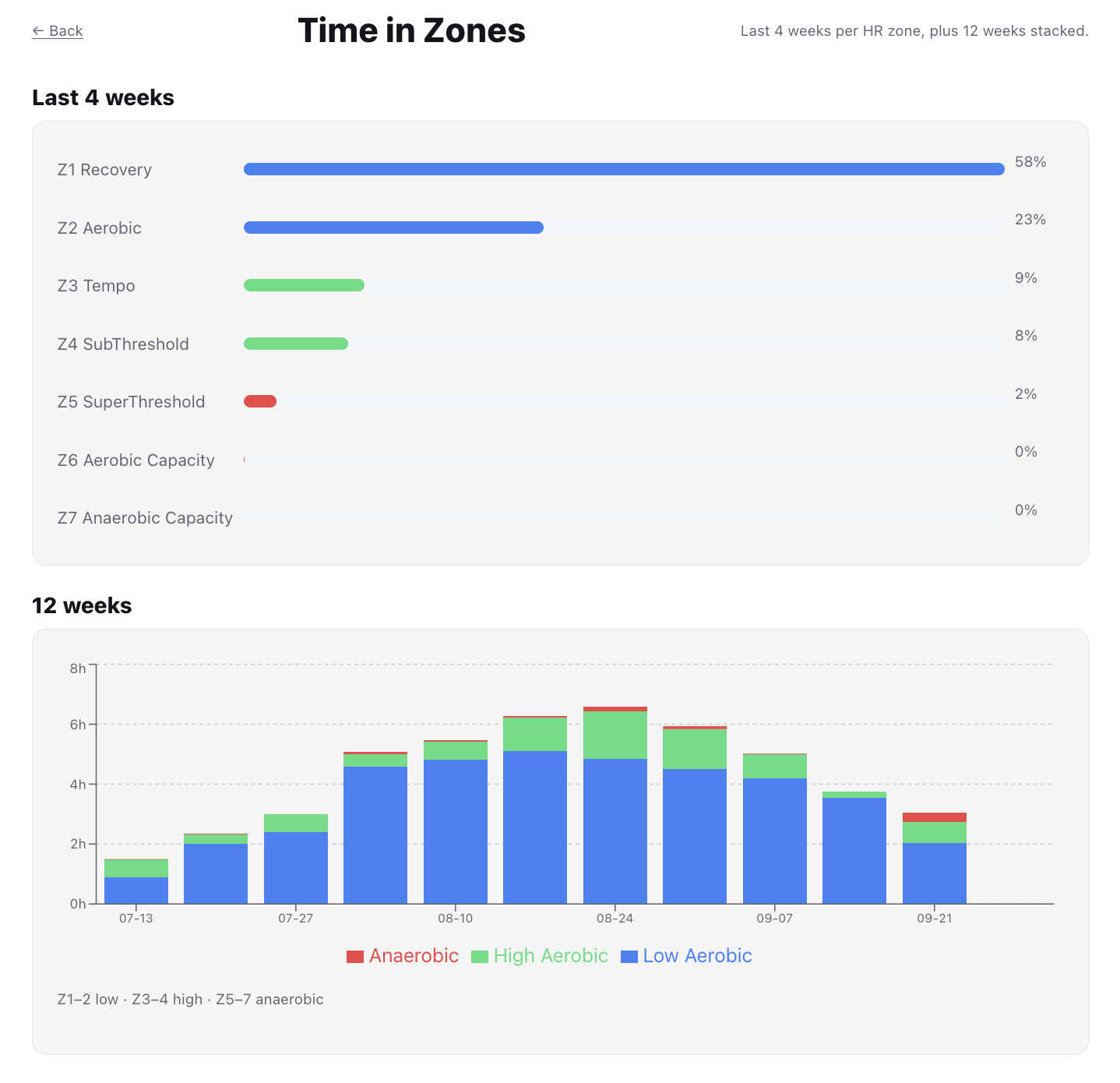
Personalization is not just about changing the name on a template. It is about making sure that the intensity, duration, and progression of the training are appropriate for the athlete doing the work.
An easy run should be easy enough to support recovery. A threshold session should be hard enough to develop the intended ability, but controlled enough to be repeatable. The quality of a workout depends on getting that balance right.
Basic abilities first, advanced abilities on top
One of the most important ideas in Friel's methodology is that running fitness is not a single quality. It is built from several distinct abilities, and those abilities should be developed in a sensible order.
Basic abilities
Aerobic Endurance is the foundation: the ability to run comfortably and efficiently for a long time. It is developed primarily through easy and steady running.
Muscular Force is the ability to produce and maintain force while running. Hill work and strength-oriented training help develop the durability needed to maintain running form under load.
Speed Skills are the technical foundation of faster running. Drills and short strides help develop coordination, efficiency, and the ability to run with good form at higher speeds.
Advanced abilities
Muscular Endurance is the ability to sustain a relatively high level of force over time. Tempo and threshold work develop the capacity to maintain a demanding pace without excessive fatigue.
Anaerobic Endurance is the ability to sustain high-intensity efforts. VO2max intervals and other hard, race-specific sessions develop this quality.
Sprint Power is the ability to produce short, explosive efforts. It contributes to top-end speed and the ability to accelerate when it matters.
The distinction between these abilities matters because they do not all need to be emphasized equally at every stage of training.
A base period generally places more emphasis on the basic abilities. As the race approaches, the training shifts toward the advanced abilities that are most relevant to the event. A taper then reduces training load while maintaining enough intensity to help the athlete arrive ready to perform.
This is periodization in practice: not simply doing different workouts each week, but changing the emphasis of training as the athlete develops.
Every 42Endurance workout is associated with the ability it is designed to develop. That makes the purpose of a session clear, and helps ensure that the training plan is building toward something rather than simply filling a calendar.
Built around your actual race
A training plan needs a specific objective.
A distance, a race date, and a target time provide the anchor around which the training is organized. From there, the plan can determine an appropriate progression, the timing of different training phases, and the eventual taper.
The goal is not to follow a generic template and hope it fits. It is to build a training process that makes sense for the race you are actually preparing for.
Change the race, and the training priorities may change with it. A 5K, a half marathon, and a marathon do not require the same balance of abilities, even when the underlying training principles are similar.
Training load is part of the plan
Completing a workout is not the same as absorbing it.
That is why 42Endurance considers training load alongside the structure of the plan. Fitness, Fatigue, and Form provide a way to monitor how training is accumulating and how much fatigue you may be carrying.
The aim is not to chase a particular number. It is to understand whether the current training load supports the next stage of development.
A rising fitness trend can be encouraging, but it is not automatically a reason to add more training. Likewise, a temporary drop in form is not necessarily a problem — sometimes it is simply the result of doing the work required to become fitter.
The important question is whether the training is progressing toward the goal, and whether the athlete is recovering well enough to continue.
Structured workouts, without the extra admin
Once a plan is built, the workouts can be sent to your supported watch as structured sessions.
That means the intended intervals, durations, and targets are available when you train, rather than requiring you to remember or manually enter them.
The technology is not the training philosophy. It is simply a way to make the plan easier to follow.
Why this matters
The difference between a generic plan and a well-constructed training plan is not that one contains workouts and the other does not.
It is that a good plan understands why those workouts are there, how they fit together, and when they should be emphasized.
42Endurance brings together established training methodology, personalized intensity targets, training-load analysis, and structured workouts to make that process more coherent and practical.
The goal is not to promise that every race will go exactly as planned. Training is never that predictable.
The goal is to give you a plan with a clear purpose — one that develops the abilities you need, manages the load you are carrying, and helps you arrive at the start line prepared to perform.
Train with purpose. Race with confidence.